
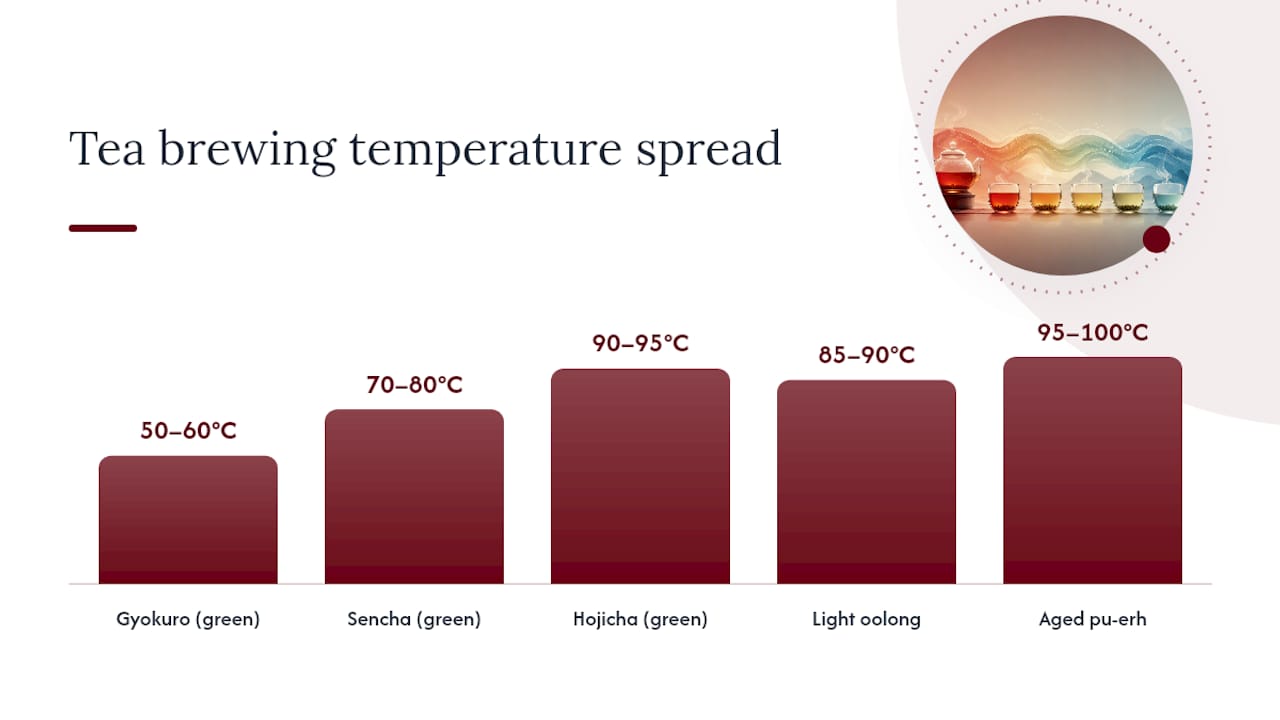
The single most important variable in a good cup of tea is water temperature, and the rule is simple: delicate, lightly processed teas need cooler water (around 70–80°C / 158–176°F), while fully oxidized, roasted, or herbal teas need near-boiling or full boil (95–100°C / 203–212°F).
| Tea Type | Temperature | Steep Time |
|---|---|---|
| Green (delicate/Japanese) | 70–75°C / 158–167°F | 1–2 min |
| Green (regular/Chinese) | 75–80°C / 167–176°F | 2–3 min |
| White | 75–85°C / 167–176°F | 3–5 min |
| Oolong (light) | 85–90°C / 185–194°F | 2–4 min |
| Oolong (dark/roasted) | 90–95°C / 203°F | 3–5 min |
| Black | 95–100°C / 203–212°F | 3–5 min |
| Pu-erh | 95–100°C / 203–212°F | 2–4 min |
| Herbal / Rooibos | 100°C / 212°F | 5–7 min |
To approximate the right temperatures without a variable kettle: boil water, then wait for a time to allow cooling, or pour between vessels once to lower the temperature slightly.
Key Takeaways
Matching water temperature to leaf processing level is the single most reliable way to improve every cup you brew.
| Point | Details |
|---|---|
| Delicate teas need cooler water | Green and white teas brew best at 70–85°C; boiling water causes bitterness and scorches the leaf. |
| Robust teas need near-boiling water | Black, pu-erh, and herbal teas require 95–100°C to fully extract flavor and body. |
| Temperature before time | When a cup tastes bitter or weak, adjust temperature first, then steep time, then leaf ratio. |
| Equipment matters for delicate teas | A variable-temperature kettle or instant-read thermometer pays off quickly if you brew greens or whites regularly. |
| Botanicals have their own rules | Heat-sensitive florals like rose and calendula brew best at 80–85°C; roots like ginseng need sustained heat closer to 88°C. |
Table of Contents
- What does the full tea water temperature chart look like by type?
- How do you measure and control water temperature accurately?
- How do you prepare loose-leaf tea for the best results?
- Why does water temperature affect tea flavor so much?
- How do you fix bitter, weak, or cloudy tea?
- When is tea safe and pleasant to drink?
- How Aurumhaus thinks about botanical blends and temperature
- A note on experimenting at the kettle
- Sources
What does the full tea water temperature chart look like by type?
The mini chart above covers the basics. The table below goes deeper, because the difference between a gyokuro and a hojicha, or a young sheng pu-erh and an aged shou, is not cosmetic. Getting the temperature wrong by even 10°C on a gyokuro turns a sweet, umami-rich cup into something flat and grassy.
According to SteepAtlas’s detailed brewing chart, gyokuro can be brewed as low as 50°C / 122°F, while roasted oolongs and shou pu-erh need near-boiling water to open up properly. That is a 50-degree spread within teas people casually call “green” or “pu-erh.”
| Tea Family | Subtype | °C Range | °F Range | Western Steep | Notes |
|---|---|---|---|---|---|
| Green | Gyokuro | 50–60°C | 122°F | 2 min | Very low temp preserves umami; never rush |
| Green | Sencha | 70–80°C | 158–176°F | 1–2 min | Upper range for bolder sencha |
| Green | Hojicha | 90–95°C | 203°F | 30 sec–1 min | Roasted; handles heat well |
| Green | Chinese (dragonwell, etc.) | 75–85°C | 167–176°F | 2–3 min | Slightly more forgiving than Japanese |
| White | Silver Needle / Bai Mu Dan | 75–85°C | 167–176°F | 3–5 min | Higher end for older or compressed white |
| Oolong | Light (high-mountain, dancong) | 85–90°C | 185–194°F | 2–4 min | Dancong benefits from gongfu short pours |
| Oolong | Dark / Roasted (Da Hong Pao) | 90–95°C | 203°F | 3–5 min | Near-boil unlocks roasted depth |
| Black | Assam, Ceylon, Darjeeling | 95–100°C | 203–212°F | 3–5 min | Darjeeling first flush: 85–90°C |
| Pu-erh | Young sheng | 85–90°C | 185–194°F | 30 sec–2 min | Aggressive extraction; gongfu preferred |
| Pu-erh | Aged sheng / Shou | 95–100°C | 203–212°F | 30 sec–2 min | Full boil opens compressed leaves |
| Herbal / Rooibos | All types | 100°C | 212°F | 5–7 min | No Camellia sinensis; full boil is safe |
Gongfu vs. Western method: Gongfu brewing uses a high leaf-to-water ratio with very short steeps, often 20–45 seconds. Because extraction is already aggressive at that ratio, practitioners often drop temperature 5–10°C below the Western recommendation for the same tea to avoid over-extraction. A dancong you’d brew at 90°C for 3 minutes Western-style might work better at 85°C for 30-second gongfu pours. SteepAtlas covers these method-specific differences in detail if you want to go further.
How do you measure and control water temperature accurately?
You have three realistic options, and the right one depends on how often you brew delicate teas.
Option 1: Variable-temperature electric kettle. This is the most consistent approach. Set the target temperature before the water heats, and the kettle holds it. If your kettle has presets (common increments: 60°C, 70°C, 80°C, 85°C, 100°C), verify accuracy against an instant-read thermometer at least once. Kettle presets can run slightly off target, which can affect delicate teas like gyokuro but is less important for robust teas like black tea.
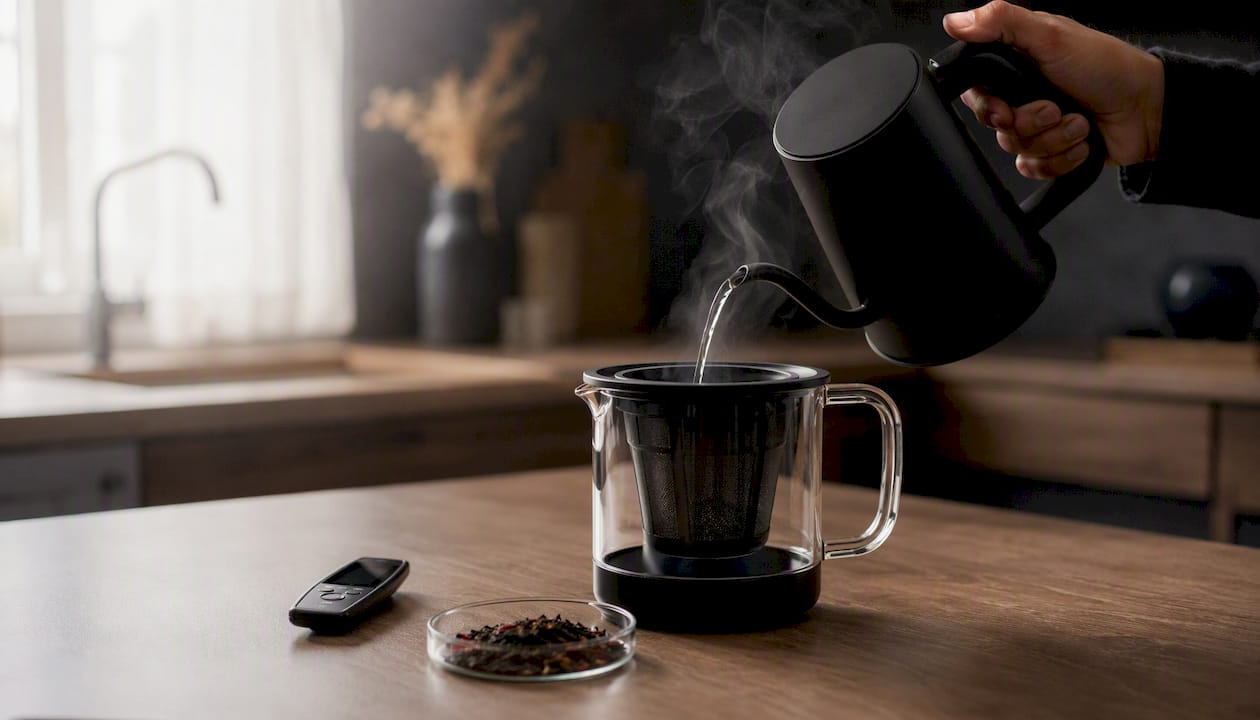
Option 2: Instant-read thermometer. A probe thermometer (like a Thermapen or any fast-read kitchen model) gives you a reading in 2–3 seconds. Boil water, then watch the temperature drop and pour when you hit your target. Slower to use than a variable kettle but more precise than guessing.
Option 3: Wait/cool method. Boil water, then let it sit. At sea level, water drops roughly 10°C every 2–3 minutes in an open kettle. Two quick pours between vessels drops temperature approximately 15–20°C total, per the SteepAtlas pour-cool guidance. For a 75°C target from boiling, that is roughly two pours or a 5–7 minute wait.
Visual bubble cues are a traditional shortcut, though imprecise:
- Tiny bubbles forming on the bottom: approximately 70–75°C
- Small strings of bubbles rising: approximately 80–85°C
- Full rolling boil: 100°C at sea level
Altitude note for Canadian brewers: Water boils below 100°C at elevation. For example, in Calgary, water boils slightly below 100°C, and this local boiling point serves as the ‘full boil’ reference when brewing black teas and herbals at high altitude.
The Tea Hearth’s practical cooling guide is worth bookmarking if you prefer the wait-and-pour approach over equipment.
Pro Tip: Pre-warm your brewing vessel by rinsing it with hot water before adding your leaves. A cold ceramic teapot can drop water temperature by 5–10°C on contact, pulling you out of your target range before steeping even begins.
How do you prepare loose-leaf tea for the best results?
Temperature alone does not make a great cup. The leaf-to-water ratio and vessel choice shape what that temperature actually does to your tea.
Leaf-to-water ratios:
- Western method: 2–3 g of leaf per 250 ml (8 oz) of water for most teas; up to 4 g for black teas
- Gongfu method: 5–8 g per 100 ml, sometimes more for compressed pu-erh
- Herbal blends: 2–4 g per 250 ml, depending on botanical density
Vessel choices and heat retention:
- Gaiwan (porcelain): Excellent control, cools quickly, ideal for gongfu and temperature-sensitive greens
- Yixing clay pot: Retains heat well; better for oolongs and pu-erh that want sustained warmth
- Western ceramic teapot: Versatile but loses heat faster than clay; pre-warming is non-negotiable
- Glass or stainless infuser: Convenient but thin walls mean faster temperature drop; fine for black and herbal teas
When to rinse your leaves: Pu-erh and compressed cakes benefit from a quick rinse, sometimes called an “awakening” pour. Use water at your target brewing temperature, pour over the leaves for 5–10 seconds, then discard. This opens compressed leaves and removes any storage dust. For loose-leaf greens and whites, skip the rinse entirely.
Multiple infusions: Most quality loose-leaf teas yield 2–4 infusions. Each subsequent steep can tolerate slightly higher temperature or longer time as the leaf opens. A sencha that starts at 75°C for 90 seconds might take 80°C for 2 minutes on the third pour.
Pro Tip: Store your loose-leaf tea in an airtight, opaque container away from heat and light. Stale or improperly stored leaves lose volatile aromatics, and no amount of precise temperature work will recover them. See how to store loose-leaf tea correctly for specifics.
Quick loose-leaf checklist:
- Measure your leaf by weight, not volume
- Pre-warm your vessel with hot water, then discard
- Heat water to target temperature
- Add leaves, pour water, start a timer
- Remove leaves promptly when time is up
Why does water temperature affect tea flavor so much?
Tea leaves contain hundreds of compounds, and they do not all dissolve at the same rate. Temperature is the dial that controls which ones dominate your cup.
Lower temperatures (70–80°C) favor the extraction of L-theanine, the amino acid responsible for umami and sweetness in green teas. Aromatic volatile oils, which carry floral and grassy notes, also release more gently at lower heat. Push the temperature higher, and catechins and tannins extract faster, tipping the balance toward astringency and bitterness. Breville’s research-backed brewing guide notes that lower temperatures reduce bitter compound extraction, which is why a 70°C gyokuro tastes nothing like the same leaf brewed at 90°C.
Leaf processing changes the equation. Oxidation breaks down chlorophyll and alters the cell structure, making the leaf more thermally tolerant. A fully oxidized black tea needs near-boiling water to extract theaflavins and thearubigins, the compounds that give it body and color. Roasted teas like hojicha or Da Hong Pao have already undergone heat treatment, so they handle high brewing temperatures without turning harsh. Fermented pu-erh, especially aged shou, needs full boil to penetrate compressed leaves and release earthy, mineral notes.
The practical takeaway: match the “energy” of your water to the processing level of your leaf. Gentle heat for gentle leaves, full heat for oxidized or roasted ones. BestTeaBags frames it clearly: most bad cups trace back to two numbers, temperature and time, and temperature is the one most home brewers get wrong first.
How do you fix bitter, weak, or cloudy tea?
Most brewing problems have a temperature or time cause. Start there before adjusting anything else.
| Symptom | Most Likely Cause | Fastest Fix |
|---|---|---|
| Bitter green tea | Water too hot or steeped too long | Drop temp 5–10°C; reduce steep by 30 sec |
| Weak black tea | Water not hot enough or too little leaf | Use near-boiling water; add more leaf |
| Astringent oolong | Oversteeping at high temp | Shorten steep; stay at lower end of temp range |
| Cloudy tea | Hard water minerals or fine leaf particles | Use filtered water; avoid agitating the leaves |
| Flat, no aroma | Stale leaves or water not hot enough | Check leaf freshness; raise temp slightly |
| Bitter herbal | Oversteeping (not temp) | Herbals tolerate full boil; reduce steep time |
A few quick diagnostic rules:
- Bitter first: lower the temperature before shortening the steep. Temperature is the bigger lever for bitterness in green and white teas.
- Weak first: check temperature before adding more leaf. Under-extracted tea often just needed hotter water, not more leaf.
- Cloudy tea is almost always a water quality issue. Filtered water makes a noticeable difference, especially in Canada where municipal water hardness varies significantly by city.
KitchenAid’s tea temperature reference recommends cooling boiled water to around 175–180°F (approximately 80°C) for green and white teas specifically to avoid the scorch and bitterness that boiling water causes.
When is tea safe and pleasant to drink?
Freshly brewed tea at 95–100°C is too hot to drink comfortably and carries a real scald risk. The pleasant drinking range for most people is around 57–63°C (135–145°F). Getting there from a just-brewed cup takes a few minutes, but you can speed it up without harming flavor:
- Pour into a pre-warmed cup, which absorbs some heat and spreads the liquid into a thinner layer that cools faster
- Pour between two cups once to drop temperature quickly
- Add a small splash of room-temperature water for black or herbal teas without noticeably diluting flavor
Iced tea: Brew at double strength (double the leaf, same water volume), then pour immediately over ice. The rapid cooling locks in volatile aromatics that would otherwise dissipate. For herbal iced teas, Aurumhaus has a dedicated method guide worth reading before you start.
Cold brew: Use room-temperature or cold water and steep for 8–12 hours in the refrigerator. Cold brew extracts fewer catechins and almost no bitterness, producing a naturally sweet, smooth cup. It works particularly well with green teas and light herbals. No temperature control needed.
Safety note for serving guests: Never serve tea above 65°C (149°F) to children or anyone with sensitivity to heat. Let it cool visibly before pouring into cups without handles.
How Aurumhaus thinks about botanical blends and temperature
Camellia sinensis leaves are built for hot water. Botanicals are not always.
At Aurumhaus, blending decisions account for the thermal behavior of every ingredient. Delicate flowers like rose petals, calendula, and jasmine release their aromatic oils quickly and can turn bitter or lose fragrance entirely above 85°C. Lemon balm is similarly heat-sensitive; its citrus-forward volatile compounds begin to degrade at prolonged high temperatures. These botanicals want water in the 80–85°C range, steeped for no more than 5 minutes.
Roots and barks behave differently. Ginseng, for example, needs sustained heat to release its active compounds. If a blend contains both ginseng and rose petals, the brewing temperature becomes a negotiation: hot enough to draw out the root, gentle enough to protect the flower.
When a blend contains both heat-sensitive florals and robust roots, brew at 85–88°C rather than full boil. This temperature extracts meaningful depth from roots like ginseng while keeping delicate petals from turning harsh. If the blend is floral-dominant with no Camellia sinensis, 80–85°C for 5–6 minutes is usually ideal.
Pro Tip: For blends that pair botanicals with green tea base, always prioritize the green tea’s temperature window. Brew at 75–80°C. The botanicals will still release flavor; the green tea base will not turn bitter.
Aurumhaus sources botanicals like saffron, calendula, and lemon balm with their brewing behavior in mind. Explore the Rare Botanicals collection to see how each ingredient is selected for both flavor and thermal compatibility. For more on choosing herbal tea blends that suit your palate and brewing setup, the Aurumhaus blog covers it in depth.
A note on experimenting at the kettle
Start with the chart. Then change one variable per session.
If your green tea tastes flat, drop the temperature by 5°C next time and keep everything else identical. If it tastes bitter, shorten the steep by 30 seconds before touching the temperature. Small, single adjustments tell you something clear. Changing temperature, steep time, and leaf ratio simultaneously tells you nothing except that something worked.
A simple tasting note takes 10 seconds: tea name, temperature, steep time, one-sentence flavor impression. After a few sessions, patterns emerge. You will find your personal sweet spot for a sencha or a white peony faster than any chart can predict, because palate preference is individual. The chart gets you close. Your notes get you there.
Creating a tea ritual that includes even a brief tasting note transforms brewing from a habit into a practice.
Sources
These are the primary references used throughout this article, each worth bookmarking for different reasons:
- Tea water temperature: Best settings for every tea
- Tea Brewing Water Temperature: Complete Chart by Tea Type
- Water Temperature for Tea: The Right Heat for Every Type · The Tea Hearth
- Tea Brewing Temperatures & Steep Times: The Complete Chart (2026) | Best Tea Bags
- Tea temperatures: a guide to brewing tea | KitchenAid US
0 comments